Theophany Cold Plunge
We are continuing to remove some of the paywalls and update some of the content for this the second year of Phroneo. Please enjoy this post originally published here a year ago and share it with your friends and relations!
In the Tabletop Book for Clergy, a comprehensive instructional manual on many practical aspects of ministry in the Orthodox Church, published in 1893 in Kharkov (present-day Ukraine), its author, Sergei Bulgakov, made the following note about bathing in ice water on Theophany:
“In some places, there exists a custom to bathe in rivers (specifically, this bathing is for those who during the holy days [the period between Christmas and Theophany] wore costumes [a tradition common among the Slavs and somewhat reminiscent of Halloween], practiced divinations, and did other such things, and superstitiously ascribe to this bathing the power to cleanse them from all of these sins). This custom cannot be justified as a desire to imitate the example of the Savior who immersed in water, or the example of Palestinian faithful who bathe in the Jordan at any time. In the East, it is safe for the faithful, because they do not have such cold and such freezing temperatures as we do. A belief in the healing and cleansing power of the water which has been sanctified by the Church on the very day of the Baptism of Christ also cannot be used to excuse this custom, since to bathe in the winter is to demand a miracle from God or to completely disregard one’s life and health.”
Fast forward a century, and this practice is now ubiquitous in all of post-Soviet Russia and anywhere that post-Soviet immigrants have settled, including in the United States. Most of Bulgakov’s work is well-researched, reasoned, and argued, but this specific note seems to fall short of the quality standard maintained elsewhere in the book… [continue]

Liturgical minyan
Behold, how good and how pleasant it is for brethren to dwell together in unity! – Psalm 133:1
In his excellent writings on the Liturgy, Father Alexander Schmemann once described a principle of correlation or concelebration which brings the laity into the equation of the Liturgy and strikes at the very heart of clericalism. Clericalism, at least as it exists in the Russian Church, seems to elevate ordained priests to some strange position within the Church. People appear to be convinced that priests are not normal humans (at least, a little bit “extra-normal”), that they have some special “superpowers” acquired through ordination, that the “Divine grace” of the ordination prayer is a special kind of grace not available to the uninitiated, and that the ordained are very much separate from the rest of the faithful, as if they were some alien beings – again, perhaps, just a little bit. While these ideas may be correct in a superficial way that is generally applicable to many professional occupations – priests do enjoy a certain level of guildic ‘separatness’ – these ideas are wrong fundamentally and theologically… [continue]
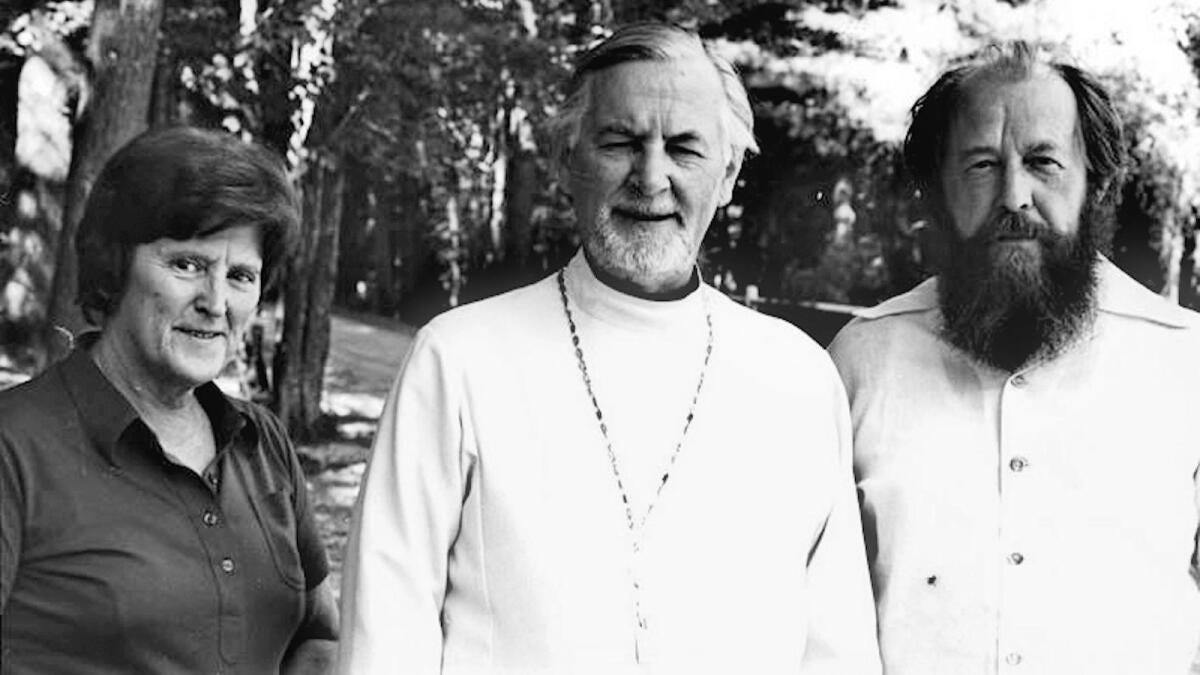
Father Alexander Schmemann (center) with his wife, Matushka Juliana (left), and Alexander Solzhenitsyn (right).
Comments Off on Liturgical minyan
From Christmas until Theophany
Typikon, ch. 48, Dec. 25:
“Let this also be understood, that from Christ’s Nativity until Holy Theophany, in no way can there be fasting or prostrations, either in churches or in cells.” (That is to say, even private asceticism should be moderated on account of the great solemnity of Christ’s Nativity.)
In other words, in this rare instance, the Typikon not only regulates public disciplines, but also private ones by adding “or in cells.” … [continue]

Comments Off on From Christmas until Theophany

 Fr. Sergei Sveshnikov
Comments Off on Theophany Cold Plunge