Fasting before the Presanctified Liturgy
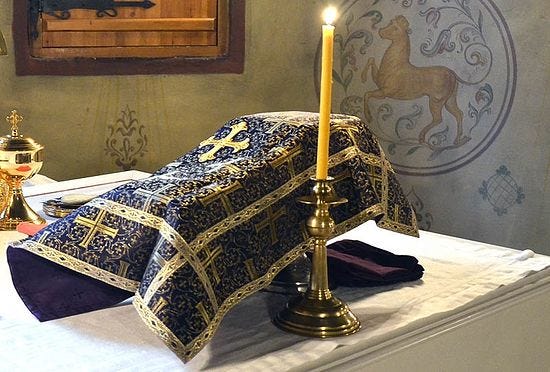
In previous posts, we briefly mentioned the concept of celebrating the Liturgy of the Presanctified Gifts at its proper time in the evening and keeping a eucharistic fast all day until Communion. Sadly, this is now very rare and even unheard of in some cases. This vesperal Liturgy is routinely served early in the morning, thus actually breaking the fast on Wednesdays and Fridays of Lent; or it is served in the evenings, but the parish priest instructs the flock to fast from noon as a matter of standard practice. Here is a typical announcement put out by one parish priest:
Just a reminder about tonight: Presanctified Liturgy at 6:00 p.m.
Fasting for those who plan to receive the Eucharist should begin at 12 noon.
Historically, the practice of Christian fasting had two simple parts: not eating and eating. The “not eating” part constitutes the actual fast, and the “eating” part is the means by which the fast is broken – for example, by eating a piece of bread or five figs or some other appropriate foodstuffs. In other words, as it relates to Lenten Presanctified Liturgies, they are purposefully designed to be celebrated following vespers – that is to say, after 3 or 4 pm – in order to accommodate fasting until evening, because partaking of Communion breaks the fast.
Paradoxically, the Church who prides herself on her patristic heritage and quasi-monastic worldview, has all but forgotten what fasting is and commonly transfers the very meaning of this word from the act of fasting to the act of breaking the fast; eating bread, or vegetables, or shrimp and fish, or even dark chocolate is now called fasting, while the remnants of actual fasting can be found only on a couple of days a year, such as Great Friday, and as a short eucharistic fast on Sunday mornings for those receiving Communion.
It is generally agreed upon among all Orthodox traditions that before partaking of Communion on a typical Sunday morning, the faithful are to abstain from food and drink from midnight, until the fast is broken by the act of receiving Communion. When it comes to the Presanctified Liturgy, however, opinions seem to differ. Below are some of the variations sorted by jurisdiction, brief commentary, canonical context surrounding the practice, and some possible ways forward. I do not provide exact sources as I think it unnecessary; but since these are direct quotations, a Curious Reader could easily paste selections into a search engine and find the relevant pages…
The First Sunday of Great Lent
Glory to God! We have completed the First Week of Great Lent. For many people, the First Week of Lent is when they try to fast or pray more than they are used to, but the rest of Lent until Passion Week is somewhat less strict. Psychologically, this is quite understandable: there is still almost a month and a half until Passion Week – a period of time that is too long for most people to continue to maintain the same intensity of asceticism. And so, many of us revert back to DEFCON 4 or even 4.5 – maintaining some notion of the fact that we are still in the middle of Great Lent, but otherwise re-entering our normal everyday routines. For most lay people (for I have no business writing to or about monastics, since I myself have never been one) this is very much normal and to be expected.
If you do not fast or do not pray – these words are not directed at you. You are free not to participate in Christian asceticism or prayer life just as a “couch-potato” is free not to exercise his body or a prodigal son has the freedom to cut himself off from the presence of his father. To be sure, there are consequences. There are always consequences. But all of us are certainly free to make our choices.
But if you want to partake of the rich ascetic heritage of the Orthodox Church, Great Lent is a good time to do so. By the end of the First Week, one of two things may have happened. Perhaps, you tried fasting and you really liked it – everything seemed renewed, bright, focused, your body felt light, your mind clear, and you looked at the approaching weekend with a bit of sadness, wishing that you could continue to fast a little longer. Or perhaps, you hated fasting, it was very difficult, you were hungry, irritable, and by Tuesday you were beginning to self-diagnose various imaginary ailments that could provide you with an excuse for a dispensation – primarily, in your own mind. (This is not to say that real ailments do not affect fasting. But real ailments are best discussed with one’s physician, not in an internet blog post.) Whichever experience of the First Week of Lent you may have had, you have many choices as we enter the Second Week…
Comments Off on The First Sunday of Great Lent
Sunday of the First Week of Lent
Sunday of the First Week of Lent
Jerusalem Typikon: two meals allowed
Studite Typikon: two meals allowed
Mount Athos Rule: two meals allowed
Solovky Monastery Rule: two meals allowed
Small Home Rule: two meals allowed
Notes and Commentary:
Comments Off on Sunday of the First Week of Lent

 Fr. Sergei Sveshnikov
Comments Off on Fasting before the Presanctified Liturgy